MTN Kitchens:
the showroom that lives in the browser.
A custom kitchen sale used to take 25 days from the first conversation to a signed order. A site visit, a hand-drawn sketch, a manual cost calculation, and a long wait. We got it to five working days without adding a single person.
MTN Kitchens does not have a showroom. No expensive lighting, no kitchens bolted to the wall, no salespeople waiting by the door. They focus on one thing: building well-made, custom kitchens as efficiently as possible, and passing that efficiency on to the customer as a shorter wait and a lower price.
The problem was that the process was not efficient. Every order started the same way. A designer would sit with the customer, draw a sketch, estimate the materials by hand, calculate the cost, and then hand the whole thing to the workshop. The hand-off happened on paper. The workshop had to re-enter every measurement. Mistakes came from the re-entry, not from the original design.
The quoting problem.
The specific problems worth naming before talking about the solution.
- The manual sketch. Every sale started with a designer sitting with a customer for two to three hours. That time had to be paid for. If the customer did not buy, it was gone.
- The hand calculation. Once the sketch was done, someone calculated the materials by hand. The calculation was slow and it was the source of most pricing errors. A screw count wrong by ten percent meant the margin was wrong by a similar amount.
- The re-entry problem. The sketch went to the workshop as a document. The workshop team re-typed every measurement into their cutting software. When the hand-written note said 2,400mm and the typist entered 2,040mm, the board was cut the wrong size.
- The 25-day wait. All of this added up to three and a half weeks between a customer saying yes and their kitchen being ready to fit. Competitors with a showroom and a faster process were winning jobs on lead time alone.
A design tool built for this specific business.
Off-the-shelf kitchen design software exists. Most of it is either too simple to be useful for a manufacturer, or so complex that a customer cannot use it without training.
We built a tool from scratch that runs in the browser. The customer walks through a series of choices: the room dimensions, the layout, the door style, the colour, the handle type. The tool shows a live 3D view that updates as they make choices. It is not a full architectural rendering. It is clear enough to make a real decision.
The design tool knows the price of every component in real time. As the customer makes choices, the total updates. There is no waiting for a quote. By the time they submit the design, they already know what it costs.
From browser to workshop saw.
The part that changed the most was what happened after the customer clicked submit.
Before the system, the submission triggered a conversation, then a manual process. After, it triggered a document. The system reads the 3D design and translates it directly into a cutting list for the workshop saw. Every board, every dimension, every edge treatment. No re-entry. No interpretation. The number on the design is the number in the cutting list.
Marco · Workshop manager, MTN Kitchens — before the system, his team spent the first hour of most mornings reconciling the orders from the previous day: checking the sketches, asking for clarifications, occasionally re-measuring because the notes were not clear. After: he opens the cutting list and the saw starts. The first hour is now production time.
What 25 days down to 5 looks like in practice.
The lead time reduction came from removing the steps that did not need a human. The designer is still involved for complex jobs or customers who want help. The difference is that their time now goes toward judgment and relationships, not manual calculation and re-entry.
For standard orders, a customer can now go from opening the browser to a confirmed order in about forty minutes. The workshop receives a clean cutting list the same day. Materials are ordered the same afternoon. The kitchen is ready in five working days.
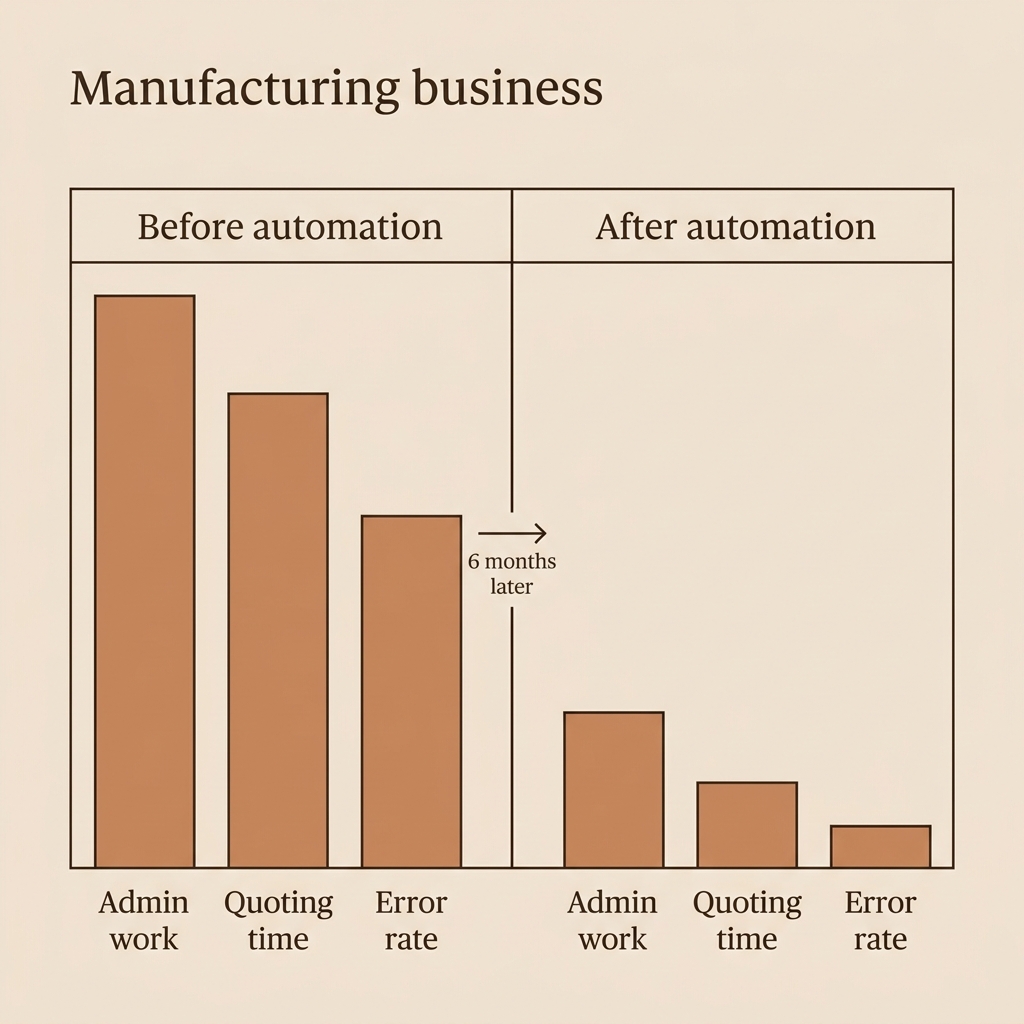
MTN Kitchens did not need more people to handle more orders. They needed the people they had to stop spending time on the parts of the process that software handles better.
What to watch for if you are considering this.
-
Generic configurator tools that do not connect to your stock.
A design tool that lets customers choose products you do not have in stock is a problem, not a solution. The tool needs to know what you can actually build. That connection is specific to your business and requires a custom build.
-
Systems that still require someone to re-enter the data.
If the customer's design still has to be typed into a separate system before the workshop can use it, you have added a step without removing one. The measure of success is zero re-entry between the customer's choices and the cutting list.
-
Quoting tools that are not connected to real pricing.
A tool that produces an estimate but not a real price creates a second conversation that undoes the speed gain. The customer already expects the price they saw in the tool. If the real quote is different, the trust is gone before the relationship starts.
The short version.
The quoting and ordering process in a manufacturing business is usually the most paper-heavy, error-prone part of the whole operation. It is also the part that determines whether a customer waits three weeks or five days. A custom tool built around your specific products, your real stock levels, and your workshop's existing process can remove most of that paper without changing how the actual work gets done.
If you run a business where every order starts with a manual quoting conversation, use the contact page. I will tell you whether a tool like this makes sense for your volume and what it would involve.